
Brau means brew: the craft beer story behind hi brau (and seven pairings to prove it)

Updated: May 15
Here's a fact most Hi Bräu customers don't know: this whole beef company started with beer.
Long before we were raising specialty cattle on our family farm in Newberry, I was the guy in the bottle shops reading every label and tracking every brew I tried in an app called Untappd. At the time of writing, that count sits at 1,914 unique beers. I don't drink them all at once (I like being alive)—these are tasting notes built up over 12+ years, the way a sommelier tracks wines or a chef tracks restaurants. Tasting widely is how you learn what good actually means, and how you tell the difference between something well-made and something just well-marketed.
What craft beer taught me wasn't only flavor. It was an attitude. Small breweries took a beverage that giant corporations had reduced to yellow, fizzy water and turned it into something obsessive, experimental, and worth caring about. They had flagship beers and special releases. They built communities. They put a stake in the ground and said we're going to do this our way. A better way.
I looked at the beef industry and saw the same problem craft brewers had solved with beer. Commodity grocery store beef is the Bud Light of red meat - optimized for shelf life, efficiency, and price, with the eating experience stripped down to almost nothing. Nobody was doing for beef what Sierra Nevada had done for beer. Nobody was raising specialty breeds, finishing them with intention, and selling directly to people who actually cared.
So I did. And I named it Hi Bräu - Bräu is German for brew - because that's what we're making here: premium brews of beef. Different breeds, different finishes, different ages, each with its own flavor profile, the way a brewery has its own lineup. Our Angus and South Poll are the flagship lineup. Our limited cuts, like Akaushi and 40 Month Live Aged, are the special releases. The experimental, "no one's done this before" nature is the whole point. And no one had done it. I checked.
So it felt only right to finally do what I should've done years ago: pair every Hi Bräu beef with the craft beer type that flatters it best. Then, I picked out one of my favorite beers in that style. I've personally tasted every beer on this list. Even better? We're all about our local terroir, and every brewery on this list is in the Southeast. I even included my personal ratings out of a possible 5 stars (I've only ever had 2 out of my nearly 2,000 beers get a 5-star rating). Pour these alongside the beef they're matched with, and you'll taste exactly why we built this company.

american akaushi (grain finished)→marzen
Akaushi, one of our rarest breeds, is a Japanese red breed prized for clean, beefy flavor with serious marbling. Grain-finished, it tastes rich and slightly sweet, with a deep crust when you sear it hard. Märzen - malty, lightly toasted, faintly caramelized - is the classic Oktoberfest pour for a reason. The bread-crust notes in the beer mirror the seared crust on the steak, and the gentle sweetness handles the marbling without competing.
The pour: Foothills Oktoberfest (Winston-Salem, NC). Toasted bread, roasted almond, dry finish. One of the cleanest Märzens brewed in the South. I gave this one 4.25 out of 5 stars.

american wagyu (grain finished)→american ipa
Grain-finished Wagyu is the richest cut on this list - buttery, melty, almost decadent. A beef this fatty needs hop bitterness to slice through. The piney, citrusy bite of a classic American IPA acts like a steak knife on the palate, resetting it between bites. Caramel malt in the background hands off cleanly to the marbling.
I'll be straight with you: I'm not the biggest IPA drinker on this list. Out of the 1,914 beers I've logged, IPAs are the style I gravitate to least. But when grain-finished Wagyu calls for hop bitterness, this is the southeastern West Coast IPA I reach for.
The pour: SweetWater Atlanta's OG IPA (Atlanta, GA). It's the flagship beer from one of the original southeastern craft breweries. SweetWater opened in 1997, when "Atlanta craft beer" wasn't really a phrase yet. Centennial, Cascade, and Simcoe hops over a clean malt backbone, 6.3% ABV, dry resinous finish. The "OG" in the name is the whole story: this is the beer that helped define what southern craft IPA could be. For a Wagyu cut that pushes the boundaries of what southern beef can be, that's the energy we're looking for. This one received 3.75 stars.

angus (grain finished)→american amber ale
Angus is the original American steak experience. Amber ale is the original American craft beer style. There's a reason these two get along: the beer's caramel malt sweetness mirrors the caramelized fond on a hot pan, and the medium body matches medium-marbled beef without overpowering it. This is the pairing equivalent of a firm handshake.
The pour: Highland Gaelic Ale (Asheville, NC). The headliner of the southern amber category, and arguably the beer that put North Carolina craft on the map. I've been drinking this one for years, and it's like a rite of passage every time I visit Asheville. 4.25 stars for this classic pour.

premium angus (prime marbling)→imperial stout
When marbling jumps from medium to prime, you need a beer that can carry the weight. Imperial stout brings roasted bitterness that cuts fat the way coffee cuts cream, plus chocolate, vanilla, and dark malt depth that mirror the toffee richness of highly marbled beef. If you've ever had Mexican mole on a rich cut of meat, you already know this works. The chocolate-and-chili profile was invented for fatty proteins.
The pour: Westbrook Mexican Cake (Mt. Pleasant, SC). Though I'm not big on IPA's, I absolutely LOVE a stout. This is a 10.5% imperial stout aged on cocoa nibs, vanilla, cinnamon, and habanero peppers, released once a year in May, and one of the most sought-after beers in the entire southeast. Hands-down one of my all-time favorite stouts.... no, no, my all-time favorite beers, full stop. I look forward to it every year, and you can always find a bottle hidden in my beer fridge for special occasions. The second-highest rated beer for me on this list at 4.75 stars.

south poll (100% grass finished)→saison
Grass-finished beef is leaner, more mineral, and carries the herbal flavor of what the animal actually ate. You don't want to bury that, you want to lift it. A saison brings earthy yeast, white pepper, and herbal complexity that meets the beef on its own terms. Add fresh basil to the saison, and you've basically replicated what a chef would do with a sprig of green and a squeeze of lemon on the plate.
The pour: Holy City Madam Basil (Charleston, SC). A French-style saison brewed with fresh basil by Holy City's women brewers. Still in my top three saisons of all time, and one that goes down perfect on a hot day...the same kind of day that our heat-resistant South Poll cattle thrive in. I gave it a 4.0 rating.
craftmaster sidebar: an Off-script pour for south poll
Saison is the right answer for grass-finished South Poll - but if you trust me, try this instead: Westbrook Gose (Mt. Pleasant, SC). It's a salty, lactic German sour, and out of the 1,914+ beers I've tracked, it is my single favorite beer in the world. The mineral salinity mirrors the oceanic note in grass-finished beef, the way flaky salt and a squeeze of lemon finish a steak. Saison is the textbook pairing. Gose is the pairing I'd pour you in my kitchen after a long, hot day working on the farm while grilling a hearty steak. As you might have guessed, this gets a perfect 5-star rating from me.
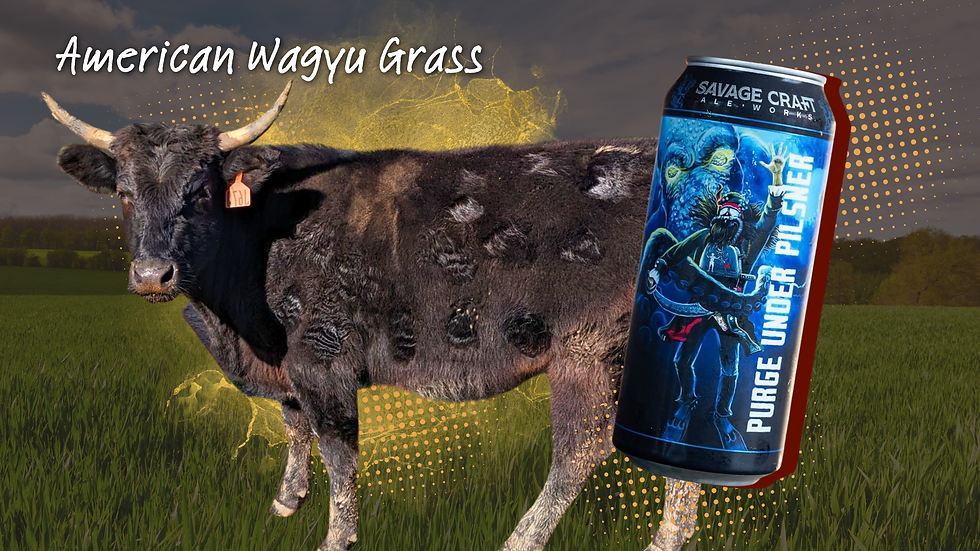
american wagyu (grass finished)→german pilsner
The grass-finished Wagyu cross is the most interesting cut on the list. You get marbling from the Wagyu genetics with the cleaner, leaner profile of grass finishing. The beer needs to match: clean, crisp, structured, with enough hop bite to refresh the palate but not enough to bulldoze the beef. A great German pilsner is exactly that — its moderate bitterness acts like a palate reset between bites, and the dry finish keeps the marbling from building up on you.
The pour: Savage Craft Purge Under Pilsner (West Columbia, SC). A German-style pilsner brewed using traditional decoction methods — the old-world process that builds malt depth you can't shortcut. Crisp, golden, dry-finishing, and a 2024 South Carolina Brewers Cup medalist in the European Lager category. I gave it a 3.75 on Untappd, one of the better German-style pilsners I've tasted in this state, and I don't say that lightly. Savage Craft is also one of our restaurant partners, which means you can order Hi Bräu beef and pour this pilsner at the same table. That's not a coincidence; that's how it's supposed to work.

40-month angus (100% grass finished, aged)→belgian quadrupel
Forty-month-old grass-finished beef is the most distinctive product we sell. The age concentrates everything - flavor, funk, depth, marbling - into something almost gamey, like dry-aging dialed up to a place most beef will never go. A Belgian quadrupel is the only style I've found that meets it head-on: dark fruit, raisin, warming spice, Belgian yeast complexity, and barrel character that mirrors the aged depth of the beef.
The pour: Sierra Nevada Trip in the Woods Barrel-Aged Quad (Mills River, NC). Yes, Sierra Nevada is technically Californian by birth, but their North Carolina operation is the real deal and earns the southeast nod here. Deep ruby-brown, rich dark fruit, rum-barrel sweetness, and the kind of cellaring potential you usually only find in Belgian Trappist beer. A perfect closer for a perfect cut. Though I'm not too big on Belgians, this one actually got a 4.25 rating.

bonus round: hb pasture-raised pork→vienna lager
We don't just raise beef. Our Duroc and Berkshire pigs live on pasture with free-choice grain, which gives the meat a depth and sweetness that grocery store pork simply doesn't have. Real pork fat tastes like something - nutty, clean, almost buttery- and it deserves a beer that respects that instead of bulldozing it.
Pork is a different pairing problem than beef. The fat is softer, the flavor is more delicate, and the heavy stouts and bitter IPAs we've been talking about all afternoon are the wrong tools for the job. You want something amber, malt-forward, and clean. A beer that mirrors the toasted, slightly sweet character of well-raised pork without competing with it. The textbook answer is Vienna lager: amber-hued, lightly toasty, gently sweet, dry-finishing, and old-world enough to feel like it was made for charcuterie boards and roast pork dinners. Because it basically was.
The pour: New Realm Helluvienna Lager (Greenville, SC). A traditional Vienna-style amber lager built on pilsner, Vienna, Munich, and Carared malts with German Hersbrucker hops - about as faithful to the Austrian original as you'll find brewed in the South. 5.2% ABV, crisp, clean, and built for food rather than for showing off. New Realm was co-founded by Mitch Steele, the longtime brewmaster at Stone Brewing and one of the most respected names in American craft beer, which tells you everything about the precision behind a beer this restrained. It's exactly the kind of pour I want next to a pork shoulder coming off the smoker. Our rating is a 4.0.
This is just the tip of the iceberg, though. Bacon wants a different beer than a fried pork chop. A smoked Boston butt wants a different beer than a slow-braised shoulder. Coming soon: a deep-dive pork pairing post, breaking down beer matches for some of the major cuts we sell - sausage, chops, ribs, butt, belly, and some under-loved cuts most people skip. Stay tuned.
why our craft Beer pairing matters
Hi Bräu exists because craft beer existed first. Every breed we raise, every finishing protocol we use, every box we ship - it all comes from the same impulse that turned beer from a commodity back into a craft. We have our on-tap regulars (the Angus and South Poll) and our limited releases (Premium, Wagyu). We experiment. We obsess over details. We're trying to do for beef what the breweries on this list have done for beer. We're here to prove that not all beef tastes the same. A good craft beer pairing does just that.
Pour one of these alongside one of ours. That's how you taste what we're up to.
- Ben Setzler, Founder, Hi Bräu Crafted Beef Co.

Comments